
How Technology is Redefining Physiotherapy Education
Summarize this article with:



- 1. The Shift: From Hands-On to Tech-Driven Care
- 2. The Real Challenge: The Education Gap
- 3. Why Industry – Academia Collaboration Matters
- 4. The Role of Digital Platforms in Learning
- 5. Why Digital Skills Are No Longer Optional
- 6. What This Means for Students and Professionals
- 7. The Future is Clear: Smarter, Faster, Better Care
- 8. Final Thoughts
- 9. Transcript for PlusPhysio Ganpat University Collaboration
The world of physiotherapy is changing – and faster than most people realize.
What once relied heavily on manual techniques and traditional training is now evolving into a data-driven, technology-enabled discipline.
For academia, this shift means integrating digital literacy, clinical software, and healthcare IT tools into the learning journey.
- Classrooms turned into labs
- Theory transformed into tech driven practice.
Students get hands-on experience with real-world platforms. Professors bring innovation into teaching. Institutes strengthen their reputation through tech adoption and industry collaboration.
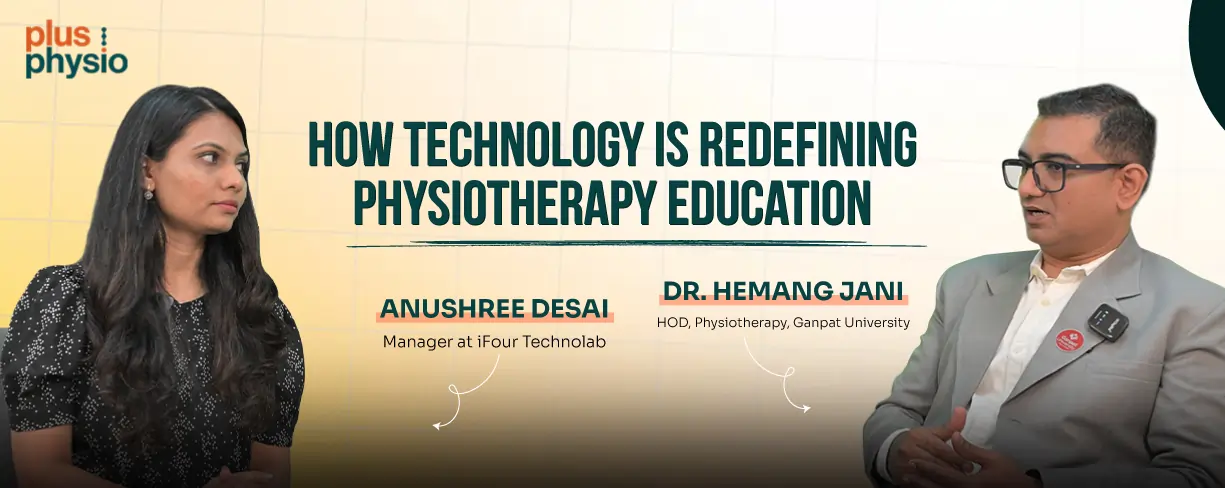
Recently, Ganpat University’s Subhadraben Sureshchandra Institute of Physiotherapy (SSIOP) officially signed an MoU (Memorandum of Understanding) with PlusPhysio, an AI-powered Physiotherapy software powered by iFour Technolab, in October 2025.
Following this, we spoke with Dr. Hemang Jani, Head of Physiotherapy, to understand how technology and software are shaping the present and future of physiotherapy education.
And here is what has been cleared:
The future of physiotherapy is no longer just clinical – it’s digital.

The Shift: From Hands-On to Tech-Driven Care
Physiotherapy has always been about precision, personalization, and patient care. But today, technology is redefining how these outcomes are achieved.
According to Dr. Jani, the industry is gradually integrating:
Digital tools
Data-driven assessment methods
AI and modern clinical systems
These shifts are enabling physiotherapists to:
Make more accurate decisions
Improve patient outcomes
Deliver faster and more efficient care
Simply put, physiotherapy is no longer limited to physical techniques – it’s becoming smarter and more connected.
The Real Challenge: The Education Gap
While the industry is evolving rapidly, education systems are still catching up.
One of the biggest concerns highlighted in the discussion is the gap between classroom learning and real-world clinical practice.
Students often graduate with theoretical knowledge but struggle when exposed to:
- Real patient scenarios
- Digital documentation systems
- Practical decision-making environments
This gap creates a disconnect that affects both confidence and performance in early careers.
Why Industry – Academia Collaboration Matters
So, how do you bridge this gap?
Dr. Jani emphasizes one critical solution: strong collaboration between educational institutions and industry platforms.
When students get access to:
Real-world tools
Live clinical workflows
Practical exposure
They don’t just learn – they adapt, experiment, and grow.
This collaboration ensures:
Better job readiness
Faster skill development
A smoother transition into professional practice
The Role of Digital Platforms in Learning
Modern platforms like PlusPhysio are playing a crucial role in this transformation.
They allow students to:
- Practice digital documentation
- Access structured clinical workflows
- Learn beyond textbooks
Instead of passive learning, students actively engage with real-world scenarios, making them more confident and competent professionals.
The result?
A generation of physiotherapists who are not just qualified – but future-ready.
Why Digital Skills Are No Longer Optional
Here’s the reality:
If you want to succeed in modern physiotherapy, digital skills are not optional – they’re essential.
Today’s physiotherapist is expected to be:
Clinically skilled
Technologically aware
Data-driven in decision-making
Understanding digital systems helps in:
Better patient tracking
Accurate reporting
Improved treatment planning
This shift is turning physiotherapists into hybrid professionals – blending healthcare with technology.
What This Means for Students and Professionals
If you’re a student or a practicing physiotherapist, this transformation directly impacts you.
To stay relevant, you need to:
- Keep learning
- Adapt to new tools
- Embrace technology early
As Dr. Jani points out, the combination of clinical expertise + digital knowledge will define success in the coming years.
The Future is Clear: Smarter, Faster, Better Care
The direction is undeniable.
Physiotherapy is moving toward a future where:
Technology enhances human expertise
Data supports clinical decisions
Learning becomes practical and continuous
And while the core of physiotherapy remains rooted in patient care, the way care is delivered is evolving rapidly.
Final Thoughts
If there’s one takeaway from this conversation, it’s this:
The future of physiotherapy belongs to those who are willing to adapt.
Whether you’re a student, educator, or healthcare professional, now is the time to:
- Embrace digital transformation
- Bridge the learning gap
- Equip yourself with the skills that truly matter
Because in today’s world, it’s not just about treating patients – it’s about doing it smarter, faster, and better.
Stop letting manual tasks slow you down. Upgrade to AI-powered PlusPhysio and streamline your clinic with:
- Automated bookings & reminders
- 24/7 multilingual AI assistant
- Tele-consultations
- Auto-generated SOAP notes
- AI-powered recovery scores
- Secure records & easy billing
- End-to-end data security & compliance
Simplify your clinic today. Explore plans now.
Full Conversation Transcript for PlusPhysio Ganpat University Collaboration:

Recent Posts


What Problems Does AI Solve in Solo Physiotherapy?
July 04, 2025